Below the Dial: A Wolf Oven That Runs Cool
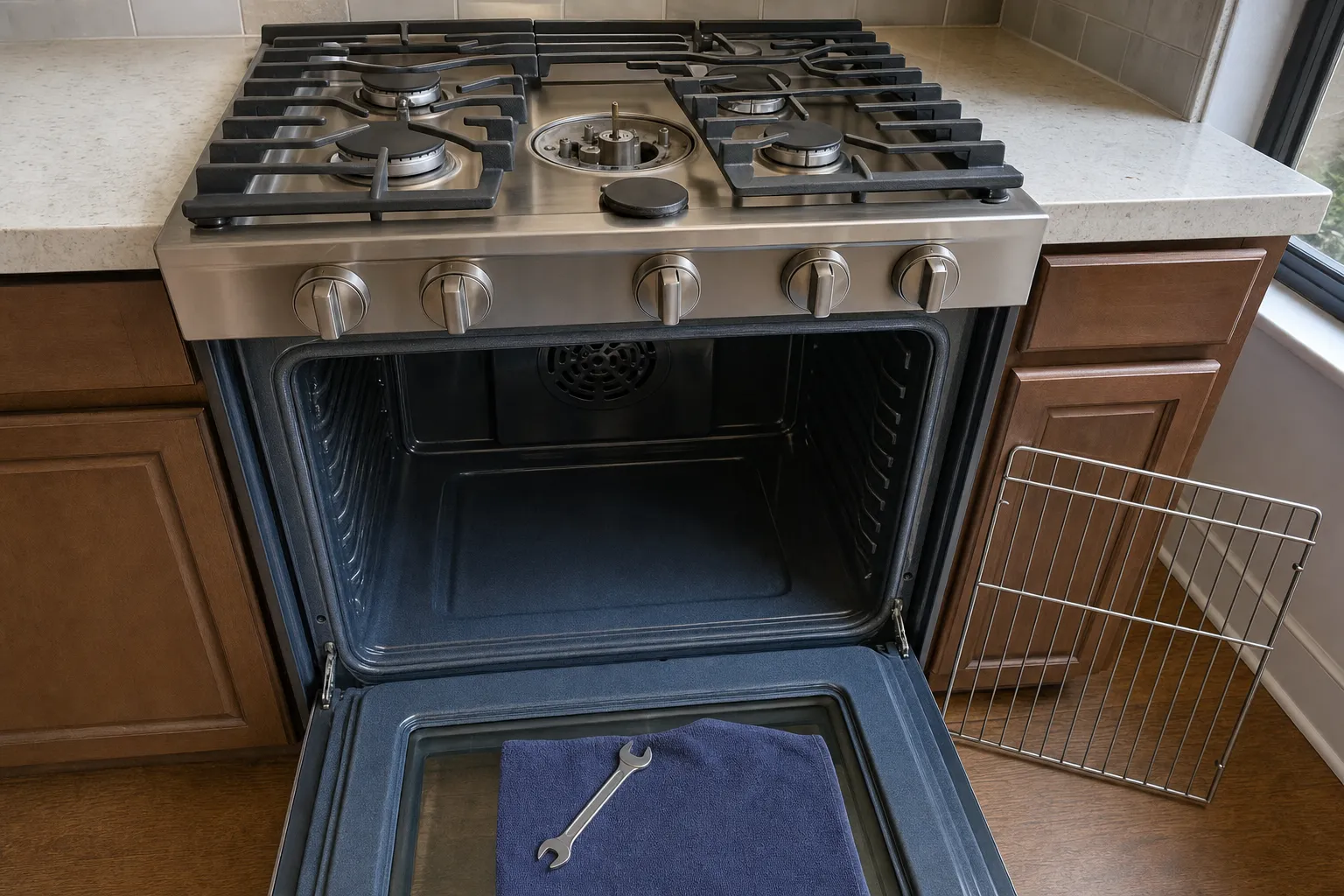
The preheat chime sounds, the light comes on, the fan runs, and a bake that used to take forty minutes takes an hour. Nothing has failed outright. On a Wolf electric oven, whether the lower half of a dual fuel range or a wall oven, that pattern has a short list of causes, and how the oven is wrong tells us more than how much.
We want a reading before a part is named, and the reading has a shape.
A reading logged over an hour
A memory of slow bakes is a real signal, but it is not yet a diagnosis. An oven cycles its heat on and off around the setting, so one glance at a thermometer catches it at the top or the bottom of a swing. What settles it is an oven thermometer in the centre of the cavity, on a middle rack with nothing else inside, read every ten minutes for an hour after the preheat chime at a single setting, and then at a higher one. An owner who has logged that before we arrive has already done part of the visit.
Four shapes, four places to look
- Steady and low. The oven holds firmly below the setting and stays there. That is a calibration-shaped error, or a sensor whose reading has drifted, so the control believes the cavity is hotter than it is and acts on that belief faithfully.
- Reaches the setting, then sags. Heat is leaving faster than it is being made. The door gasket comes first, flattened, torn or hardened, or a door that no longer closes square on a tired hinge; then an element that has lost part of its output.
- Swinging wide. The oven cycles well above and below the setting instead of holding close to it. That points to the control loop rather than the heat: a sensor slow to respond, or on a convection oven a fan that runs but has lost speed, so the sensor reads a pocket of air rather than the cavity.
- Wrong at one setting only. Right at a moderate setting and short at a high one. One heat source of several is not contributing, the bake element carrying on while the broil or a convection element does not, and the oven copes only while demand is low.
Calibration is a service setting
Wolf’s own answer on oven calibration is that adjusting the oven against its set point is possible but not commonly required, that it is done by service rather than by the owner, and that an offset moves every cooking mode at once. We set one only for a steady error that is the same at every temperature, and only after the sensor has read correctly. An offset never covers for a drifting sensor, a leaking door or an element that has half failed; it only hides them.
The parts on the bench
Each of these is a separate part on a Wolf oven, and none is a reason to replace an oven that was set into cabinetry.
- The temperature sensor. A probe at the back of the cavity, read by resistance against Wolf’s figure for that model and serial, never judged by eye.
- The door gasket and hinges. The gasket wears with heat and with being caught; a hinge that has weakened lets the door sit off square.
- The elements. Bake, broil and convection. An element can fail with visible damage or as an open circuit with none, and the meter settles it in a minute.
- The convection fan motor. One that stops is easy to hear. One that has only lost speed is quieter and easier to miss.
- The control. Read last, once everything it depends on has proven sound.
An oven that began running cool straight after a self-clean belongs with the other note on that cycle in this series, since the clean runs the cavity far hotter than cooking does. A breaker that trips, or a message on the display, ends the owner’s side at once.
Priced from the part that failed
The sensor, the door gasket and hinges, the convection fan and the control each fall in a published band; elements are quoted after the diagnosis, from the part number for that serial. The $89 visit comes off the repair once you approve it. Mercer Island Wolf Appliance Repair, (206) 785-2960.
Follow-up questions
Can the temperature offset be used to fix an oven that runs cool?
Only for a steady error that is the same at every setting, and only once the sensor reads correctly. Wolf says calibration is rarely needed, is set by service rather than the owner, and shifts every cooking mode at once. It cannot cure an oven that drifts or swings. Mercer Island Wolf Appliance Repair, (206) 785-2960, finds the cause first.
Is an oven thermometer reading worth taking before the visit?
Yes. One placed in the centre of the cavity on a middle rack, read every ten minutes for an hour after preheat, shows whether the oven is steady and low, sagging, swinging or wrong at one setting only. Each pattern points at a different part, so Mercer Island Wolf Appliance Repair asks for it when you call (206) 785-2960.
Is a forty-degree error worth repairing on an older Wolf oven?
Usually. The likely causes are the sensor, an element, the door gasket or hinges, or the convection fan, each a separate part with its own price, and none a reason to replace an oven set into cabinetry. Mercer Island Wolf Appliance Repair names the part on the $89 visit and writes the figure down before ordering; (206) 785-2960.
Filed as B4 in Two Fuels, One Range, read in order with the rest of series B.
Written up by
Imogen Fairhurst
12 years in the trade · Cooking-appliance technician — ovens and calibration